Executive teams are burning capital on AI vendor licenses that demo well but die in production. IT leaders are left managing bloated software bills and disconnected vendor tools.
Executing a successful AI adoption strategy has almost nothing to do with renting foundational models. It has everything to do with identifying operational hemorrhaging.
Starting your roadmap with “Where can we use AI?” guarantees failure. Map the operational bleed first: where is this organization losing time, margin, or data fidelity?
Stop Buying Technology Looking for a Problem
Over 80% of enterprise AI proofs-of-concept die in Pilot Purgatory. They look stunning in a controlled boardroom demo. They fall apart when exposed to legacy SAP deployments, messy workflows, and real-world edge cases.
This is the technology-first trap. You buy the license. You build the sandbox. You deploy. Then, the model crashes against legacy ERPs.
Stop buying software looking for a problem.
Customer-facing chatbots are a $500,000 trap. Enterprises frequently drop half a million dollars on generative support bots just to check a box. The result? The bot hallucinates. It frustrates high-LTV clients. It requires human intervention 40% of the time.
That is an expensive brand liability.
The “Bleed-First” Framework for Opportunity Discovery
Want immediate ROI? Target the mundane.
Stop trying to impress the board. Fix your back-office plumbing. That is where you actually protect margins.
Target Invisible Friction Over Showmanship
Deploying raw AI models directly to your external customers introduces unnecessary liabilities. Deploy AI internally as a “glass box” safety net for your workforce instead.
Look at global logistics. A freight firm handling thousands of unstructured vendor invoices across multiple languages does not need predictive macro-economic models. They need natural language processing and computer vision. They need tools that parse incoming PDFs, extract line items, and match them directly against purchase orders.
This approach is unglamorous. It also eliminates hundreds of billable hours of manual entry every week. It slashes error rates. It accelerates cash processing speed.
The Data Hygiene Prerequisite
You cannot automate chaos. If your sales representatives maintain poor Salesforce hygiene, applying machine learning for predictive lead scoring just accelerates bad decision-making.
Bad data yields bad results. AI just delivers those bad results faster, wrapped in unearned statistical confidence.
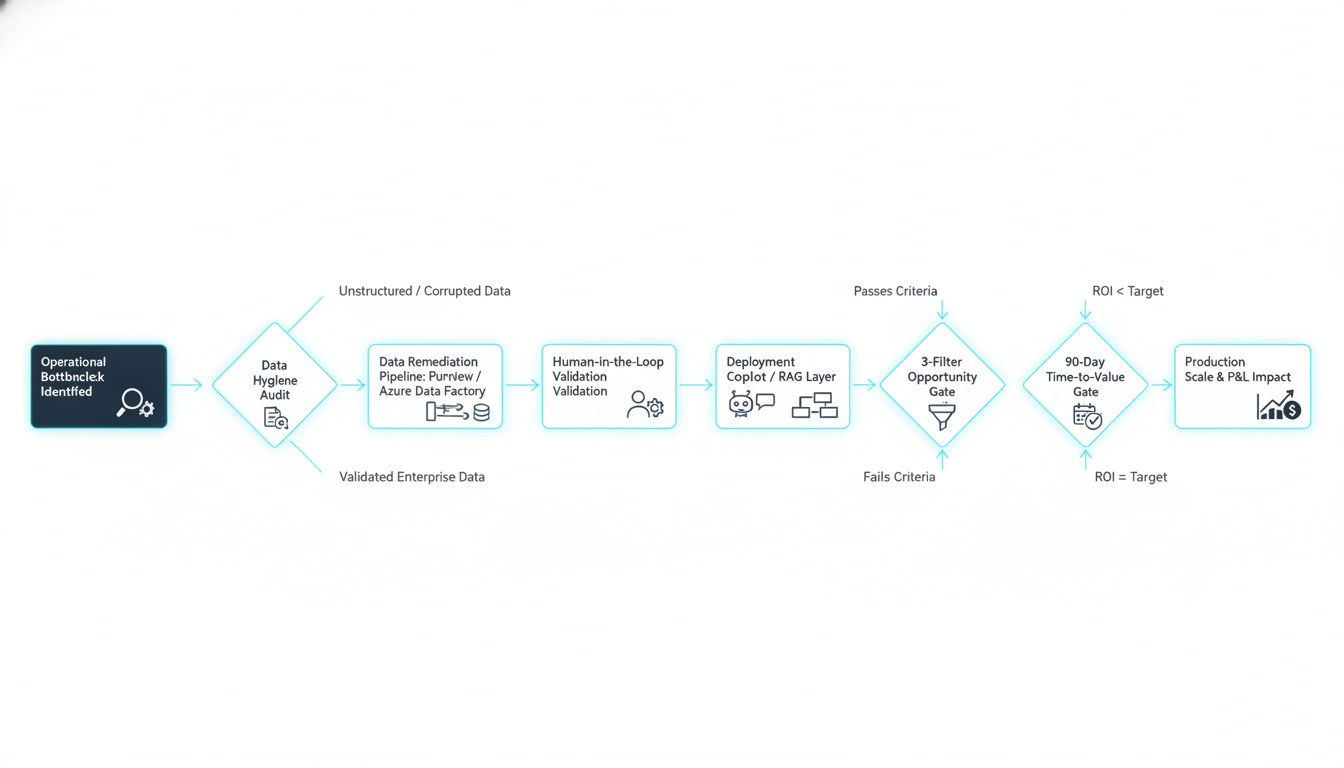
Before allocating capital to model development, audit your underlying plumbing:
- Enforce Classification: Use tools like Microsoft Purview to discover, classify, and label unstructured SharePoint data stores.
- Isolate Noise: Cleanse legacy SQL databases and establish clear governance protocols.
- Ground the Models: Utilize Retrieval-Augmented Generation (RAG) architecture to anchor model responses directly to verified enterprise documentation.
Fix the data pipeline before licensing the LLM.
The Three-Filter Test for Viable AI Use Cases
When department heads submit AI proposals, put every project through a strict evaluation filter before approving capital expenditure.
- The High-Volume, Low-Complexity Filter: Is the targeted task repetitive, rules-bound, and reliant on structured data? If the task requires nuanced human intuition, keep humans in the loop.
- The Deterministic Traceability Filter: Can success be measured mathematically on a balance sheet? Look for concrete metrics. Reduced handle time. Decreased error rates. Faster invoice processing cycles.
- The Proprietary Context Filter: Do you own the underlying business data required to make the output accurate? Without secure access to internal data, off-the-shelf models provide no durable competitive advantage.
If a project fails any of these criteria, reject the proposal.
Enforcing the 90-Day Time-to-Value Metric
Enterprise software implementations used to run on multi-year timelines. Those days are over.
Enforce a strict 90-day execution window for AI deployments. Within three months of project kickoff, a sandboxed deployment must demonstrate measurable operational relief or direct margin improvement.
If an initiative fails to hit its performance indicators within 90 days, kill the project. Reallocate the capital.
Failing fast saves budget. It also prevents technical debt from burying your IT stack.
Moving from Fragmented Experiments to Enterprise Architecture
A successful strategy requires moving from ad-hoc experimentation to institutional governance.
Isolate early deployments within sandbox environments protected by Microsoft Defender XDR to secure proprietary IP. Track exact token costs. Benchmark productivity gains against real baseline metrics. Scale only what works.
Stop chasing vendor hype. Focus on eliminating internal operational friction. The ROI will take care of itself.
Up Next: We will break down how to design a zero-trust governance model for internal Large Language Models without slowing down engineering momentum.
Need an objective assessment of your technology roadmap? Reach out to the team at SolutionXT to schedule an operational audit.