You are paying $40 a seat for corporate AI licenses, yet your senior partners are still staying up until 8 PM pasting transcript snippets into custom proposals. You are bleeding margin. Implementing AI for service businesses isn’t about generating cute marketing emails or asking a chatbot to brainstorm company retreat themes. It’s about systematically gutting the invisible administrative work that destroys your firm’s profitability.
Your top producers—the lawyers, consultants, accountants, and project directors—are drowning. They don’t need a creative muse. They need an uncomplaining administrative engine that cleans up the mess surrounding client delivery.
Stop Funding “Random Acts of AI” and Start Building Structural Scale
The average professional services firm treats AI like a novelty chrome extension. An associate keeps an open browser tab to rewrite a polite email; a project manager uses it to rephrase bullet points. We call these Random Acts of AI.
They feel productive. But they are operational quicksand.
Siloed prompt-writing creates data security liabilities and fragments institutional knowledge. It delivers zero time savings. If your billable utilization remains flat after buying enterprise AI seats, you don’t have a software adoption problem. You have an architectural failure. Real efficiency requires wiring AI directly into your workflow scaffolding.
Stop trying to replace the expert judgments your clients pay top dollar for. Instead, target the non-billable, manual data entry required to run those workflows.
The “Intake to SOW” Pipeline: Automating Pre-Service Friction
The sales-to-delivery handoff in most service firms is embarrassingly manual. Discovery notes sit in disconnected notebooks. Client onboarding drags on for weeks.
Practical AI shatters the intake bottleneck. Here is the blueprint.
1. The 80% Statement of Work (SOW) Engine
Stop letting partners draft custom proposals from a blank page. Connect your CRM and a secure large language model via standard webhooks. The second a sales discovery call ends, an automated pipeline parses the transcript, cross-references your firm’s five most profitable past proposals in that specific niche, and drops an 80% finished SOW draft directly into Google Docs or Word.
Your partners step in for 20 minutes to refine scope and pricing strategy. They stop spending four hours typing boilerplate terms.
2. Automated RFP Compliance Parsing
Inbound RFPs are designed to waste your team’s time. Instead of assigning a junior consultant to manually dissect a 90-page document into a scope matrix, run the document through a custom document-processing workflow.
The AI extracts requirements, flags non-standard legal indemnities, rates fit against your target client profile, and automatically drafts initial technical answers using your firm’s historical bid database.
3. Scope Guardrail Auditing
Scope creep doesn’t happen during delivery; it happens during contracting when fatigued partners miss vagaries in client revisions. Deploy an AI contract parser calibrated to your firm’s precise delivery standards. It highlights vague language—like “unlimited iterations” or “ongoing support”—and suggests legally precise alternatives before the contract reaches the client’s desk.
Reclaiming Billable Hours: Turning Meeting Chaos into Automated Task Deployment
Meetings are where context goes to die. Standard transcription software gives you a massive wall of text that nobody ever reads again. Practical systems turn speech directly into operational velocity.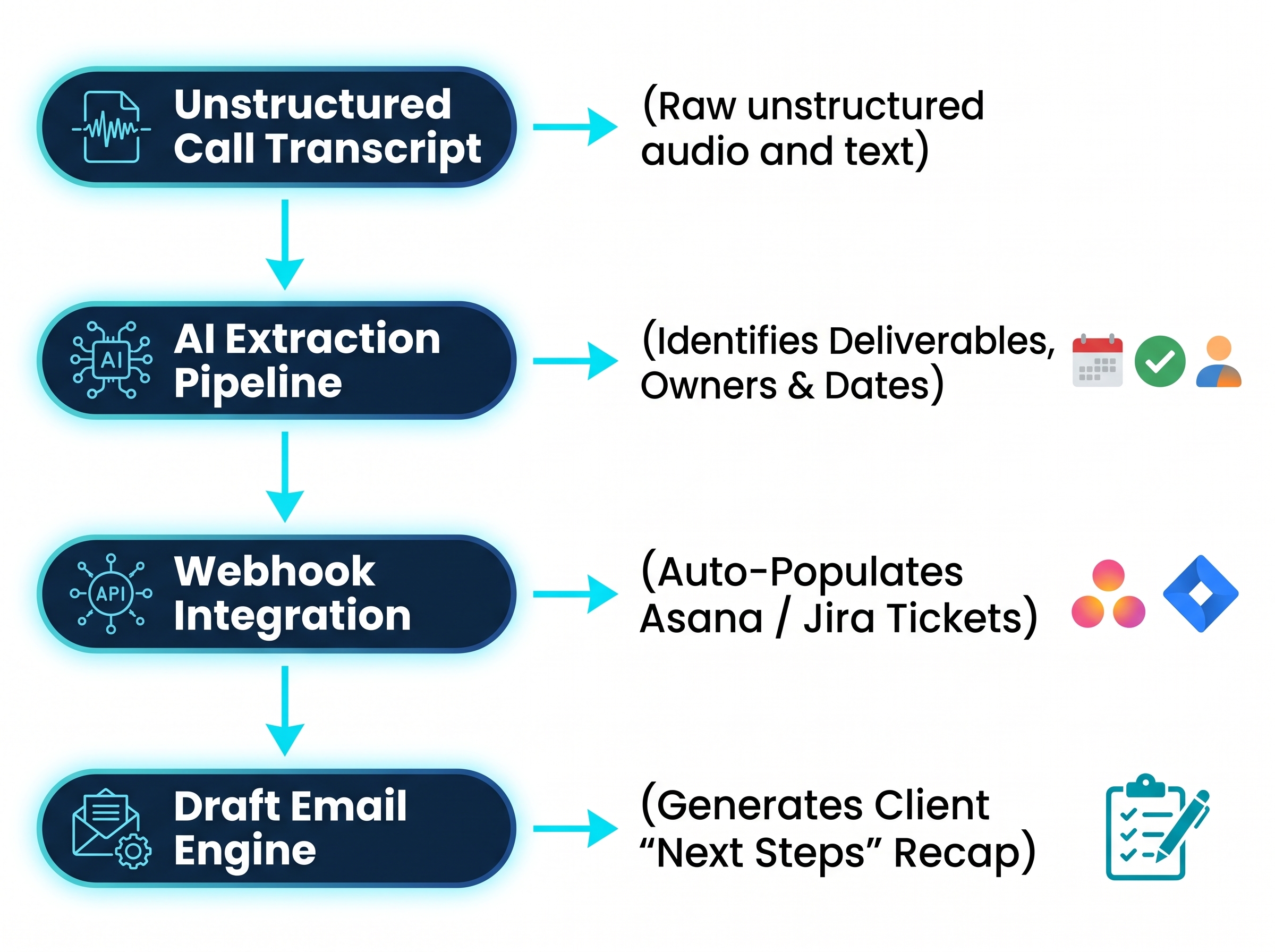
4. Direct Meeting-to-Task Execution
Don’t let your project managers spend two hours post-call manually typing tickets into Asana, Jira, or Monday. An integrated meeting assistant can parse natural conversations, pull out implicit commitments, match team members to assignments, and populate fully fledged tasks complete with deadlines and context tags.
Zero human intervention required between the call ending and the project board updating.
5. Automated Client “Next Steps” Triage
Clients want immediate reassurances post-meeting. Rather than making your delivery lead sit down to compose a thoughtful recap, build an automated draft trigger. The system processes the call notes, organizes key takeaways into your firm’s brand voice, formats specific deliverables expected from both parties, and places a ready-to-send draft directly in your account lead’s email client.
They click review and send within two minutes of hitting “Leave Meeting.”
6. Passive Time Tracker Auditing
Billable leakage kills profitability. Experts regularly forget to log half-hour phone calls or rapid-fire email exchanges. Machine learning engines running quietly in the background can analyze local app usage and sent communication metadata to map out a daily timeline of work.
Instead of building time sheets from memory on Friday afternoon, your team simply reviews an auto-populated, highly accurate log of their day.
Institutionalizing Your Firm’s Brain: Deploying AI as Your Ultimate Knowledge Worker
When a senior partner leaves a service firm, their brain walks out the door with them. Junior staff waste hundreds of hours every quarter hunting for old pitch decks or reinventing frameworks the firm solved three years ago.
7. Internal Knowledge Retrieval Systems
Build a secure, private Retrieval-Augmented Generation (RAG) system trained exclusively on your firm’s past deliverables and standard operating procedures.
When a junior analyst needs to know how the firm handled a complex corporate restructuring for an industrial client back in 2022, they don’t ping the managing director. They query the internal system: “What framework did we use for Smith Corp, and what were the primary risks identified?”
They get an immediate, cited answer grounded in your own historical data.
8. Rapid Contract and Deliverable Auditing
Before a final deliverable goes to a client, it requires quality assurance. AI auditing pipelines can scan long-form reports and complex legal briefs against firm-wide compliance checks and structural templates. The system flags inconsistencies and missing disclosures instantly, allowing senior experts to focus strictly on strategic review.
9. Real-Time Resource Forecasting
Stop relying on gut feel and messy spreadsheets to staff upcoming engagements. By feeding active project milestone dates and historical team velocity into an analytical model, you get a clear projection of delivery bottlenecks weeks before they happen. You can reassign team members or ramp up contractor support before teams burn out.
10. Automated Status Report Generation
Clients want constant visibility, but writing weekly status updates eats non-billable time like a furnace. Connect your project management systems directly to an AI synthesis pipeline. It pulls completed milestones and upcoming deadlines, transforming raw data into an executive-ready status report.
Your project managers transition from manual reporters to high-value strategic reviewers.
The Executive Mandate: Measuring AI Success in Margin Expansion, Not Prompts Generated
Hold your technology spending accountable.
If an enterprise tool cannot show a direct line to reduced administrative overhead and spiked billable utilization, it doesn’t belong in your tech stack.
| Traditional AI Approach | Practical Operational AI Architecture |
| :— | :— |
| Buying individual chatbot licenses per employee | Building integrated, automated workflows |
| Encouraging creative prompt writing | Eliminating administrative data entry |
| Fragmented usage across isolated tabs | Firm-wide systems connected via API & webhooks |
| Measuring usage by “prompts generated” | Measuring impact by gross margin expansion |
Stop playing around the edges of technology. Focus on the mundane, painful workflows that keep your team working past dinner. Automate the administrative scaffolding, protect your firm’s billable hours, and let your experts do what you actually hired them to do.
Ready to Systematize Your Firm’s Margins?
At SolutionXT, we don’t sell AI hype or generic prompt sheets. We audit, blueprint, build, and ruthlessly monitor custom operational systems for professional service firms ready to expand gross margins and reclaim billable hours.
Schedule an Operational Architecture Audit with SolutionXT today and discover where your firm is leaking billable time.