AI saves your employees time, but your business only sees financial returns when you redesign workflows. You must redirect those freed hours to valuable work. Speeding up a single task without changing your overall operating model will not improve your bottom line. Buying new software is the easy part. Turning individual speed into enterprise value takes actual management.
Why faster tasks do not equal lower costs
The core technology works well at the desk level. Workers who used generative AI recently saved about 2.2 hours in a standard week, according to data from Lifehack Method. This gives leaders a measurable foundation of time to build on.
However, individual speed does not automatically lower company costs. In fact, 97% of organizations cannot cut expenses relying solely on AI productivity measures. Analyst firm Gartner reported this finding, as noted by ESG Dive. Cost savings are not an automatic result of buying software.
Consider a customer support director who implements software that cuts email resolution time by three minutes per ticket. The director does not raise the daily ticket quota. They also do not cross-train the agents to handle outbound sales during their freed time. The agents simply work at a more relaxed pace. The department costs remain exactly the same, resulting in zero financial return for the business.
7 practical ways to use AI for time savings
To capture actual time savings, businesses must target specific processes. Generic prompts rarely change the operating model on their own. Here are seven practical ways companies successfully free up human capacity:
- Scaling customer support capacity by drafting initial responses.
- Accelerating accounting data extraction from incoming invoices.
- Automating initial code generation for software developers.
- Summarizing long meeting transcripts into immediate action items.
- Drafting standard project updates for internal reporting.
- Sorting inbound emails by urgency and department.
- Formatting raw data into standard templates for review.
Where the saved hours actually go
When leaders fail to plan for newly freed time, downstream bottlenecks eat the gains. A study from MIT Sloan tracked software developers using new tools. Despite massive increases in coding activity, this only resulted in 30% more actual software releases.
The human review processes stayed exactly the same. Speeding up one step of a process is useless if you ignore the people who approve the final product. If developers write code faster, but the quality assurance team cannot test it any faster, the extra work just piles up.
When workflows remain the same, you also lose time to unassigned idle periods. Employees will rarely volunteer that they have nothing to do. Instead, the newly saved hours simply vanish into a slower working pace or get spent fixing poor-quality machine outputs.
How to redesign workflows for a real return
You must restructure your operating models to capture newly freed capacity. Start by mapping out the entire process from start to finish. Do not just look at the single step you want to automate. Find the downstream bottlenecks that will choke on the extra volume.
This flowchart shows how management choices determine if time savings become real returns.
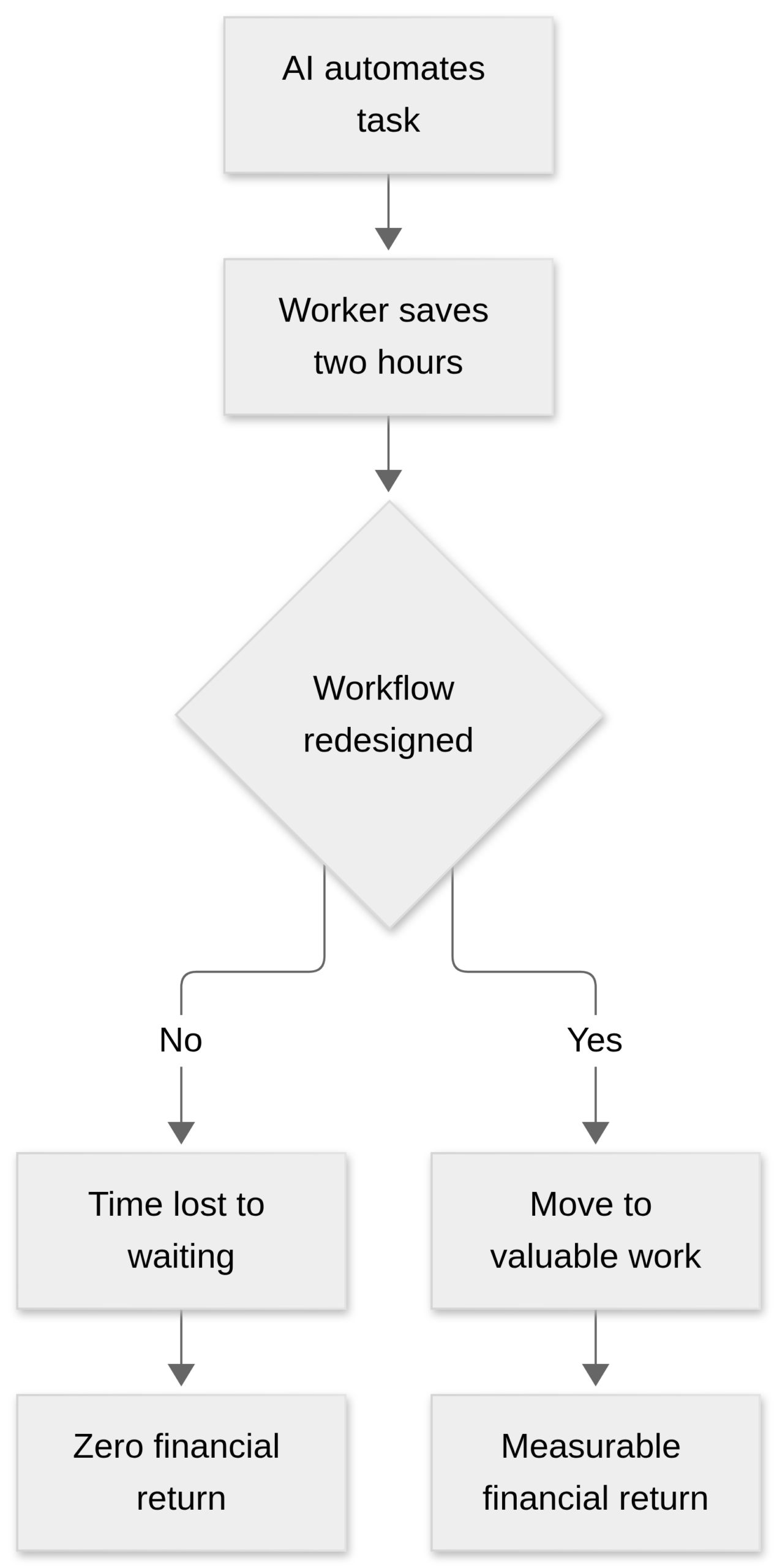
Once you identify your constraints, give your employees specific directions on what to do with their extra two hours. If you automate data entry, assign those workers to call high-value clients. If you speed up support emails, increase the daily expectations and measure the difference.
The best step you can take today is to pick one automated process and measure the hours saved. Then, formally assign a new, profit-driving task to fill that gap. If you want a second set of eyes on your operating model, reach out to us at SolutionXT.