Your firm does not have a software shortage. It has an integration crisis.
Companies spend millions buying enterprise SaaS tools, yet profit margins continue to erode. The reason is simple. Because these systems operate in isolated silos, the actual integration layer between your CRM, ERP, and project management stack is a human being.
Strategic leadership teams are inadvertently paying six-figure directors to act as manual data routers, manually migrating records just to prevent database collisions.
Deploying true business process automation is not about buying another application to digitize a broken workflow. It is an enterprise margin-protection strategy designed to stop making $200/hour architects do $15/hour data entry and accelerate time-to-revenue.
Doing nothing is no longer a neutral choice. It is a tax on your growth.
The Margin Bleed of Relying on Human Integration Layers
Buying a tool to cover up a flawed workflow yields one result: a flawed workflow that fails at scale. This “Band-Aid Automation” is why senior executives find themselves trapped in manual administrative loops.
When a $180,000-a-year Engagement Manager spends their first four days on a new account hunting down signatures, creating Slack channels, and manually setting up billing codes, your business model is broken. They are not delivering strategic enterprise value. They are operating as an overpaid IT helpdesk.
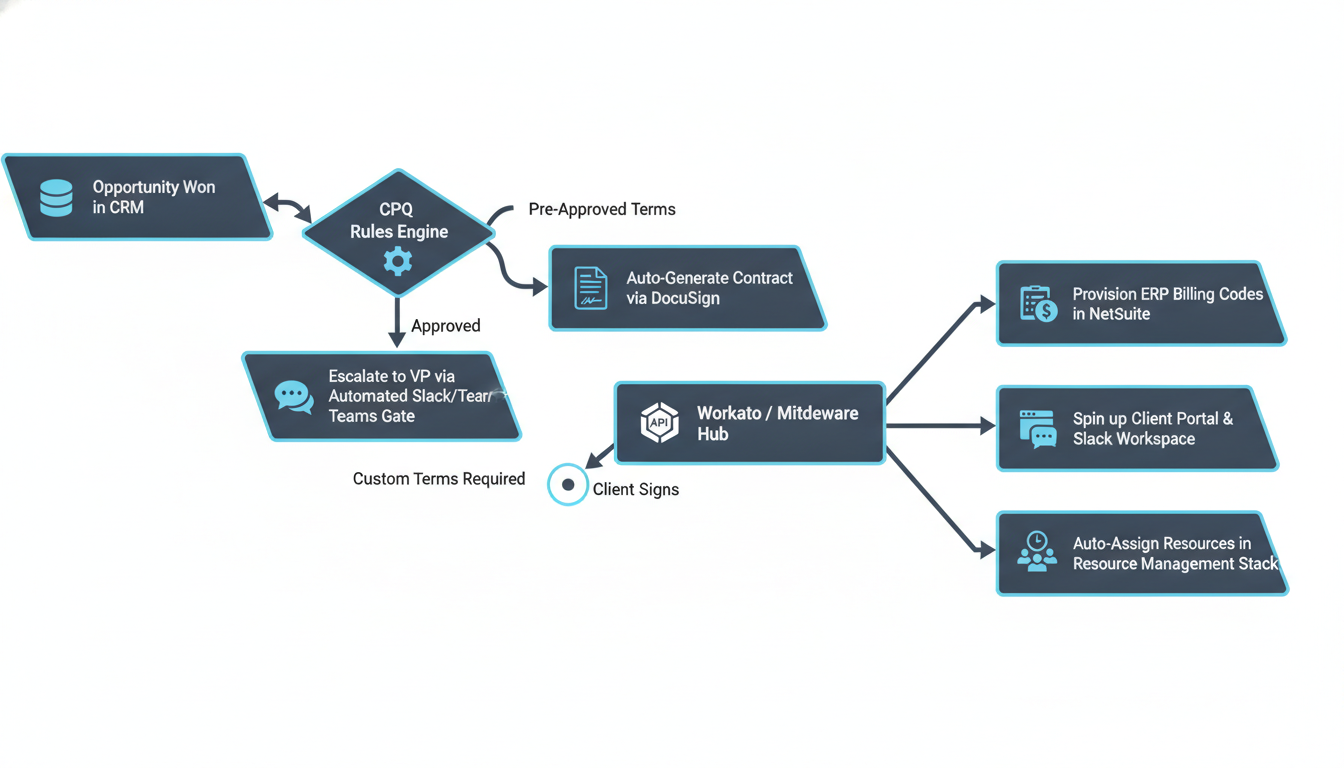
Automated Enterprise Onboarding Architecture
Figure 1: Replacing human manual integration with an event-driven automation framework.
Accelerating Time-to-Revenue: Eradicating Manual Quote-to-Cash and Contract Approvals (Processes 1 & 2)
Process 1: The Slack Approval Chokehold (Pricing & Discounting)
Sales reps negotiate custom pricing through fragmented channels—unstructured Slack DMs, buried email chains, or impromptu calls. Deals stall. Margins bleed. The VP of Sales becomes a structural bottleneck, reviewing custom terms on Friday afternoons.
By embedding logic-based decision engines into your CPQ framework (like Salesforce CPQ or Conga), pre-approved discount parameters auto-route for instant sign-off. If a deal fits standard guardrails, approval is instantaneous.
If it strays, targeted workflows push structured approval prompts directly into Microsoft Teams or Slack with single-click clearance.
Process 2: Client Onboarding and Contract Generation
Once a contract is signed, the manual clock starts ticking down your delivery margins. Creating MSAs, setting up ERP project profiles, and opening secure client communication channels manually delays time-to-revenue by days. Stop doing this.
Connect contract engines via webhooks into your core infrastructure using platform tools like Workato or Microsoft Power Automate. Signed DocuSign files automatically trigger profile generation in NetSuite, assign billing codes, and provision secure workspaces instantly.
The Utilization Fallacy: Stop Managing Enterprise Capacity in Spreadsheets (Process 3)
Firms run resource allocation on massive, fragile spreadsheets. It is a catastrophic mistake.
This creates a dangerous delay in visibility. Operations leads end up reacting to historical bench time rather than forecasting future capacity. The result is predictable: senior staff are burned out by sudden overallocation, while specialized talent sits underutilized on the bench.
- Manual Tracking: Relies on retrospective weekly timesheet submissions and static updates.
- Automated Capacity Orchestration: Connects pipeline opportunities directly with active utilization platforms (e.g., FinancialForce or Smartsheet) to dynamically reserve bandwidth 30 to 60 days before contracts are finalized.
When resource requirements are tied directly to your sales pipeline, talent planning moves from a reactive guessing game to an automated, predictable workflow.
Erasing the Executive Blindspot: Automating the Month-End Close and Profitability Tracking (Process 4)
If your CFO relies on a 45-day-old spreadsheet to make strategic operational decisions, you are navigating the business through the rearview mirror.
The monthly financial close often degenerates into a manual data-scrubbing sprint. Finance teams spend days exporting raw CSVs from disparate regional systems, manually correcting duplicate line items, and struggling to reconcile project-level profitability.
Modern enterprise architectures solve this by establishing continuous, automated data pipelines. Route operational metrics directly from field applications through platforms like Snowflake or Azure Data Factory into executive dashboards like Power BI.
Financial metrics remain up to date. You eliminate the month-end scramble and gain real-time visibility into actual project margins.
Containing Risk and Maverick Spend: The Mandate to Automate Vendor Procurement (Process 5)
Unchecked, decentralized purchasing destroys operating margins. Subcontractors are onboarded via direct email threads, statements of work bypass formal legal reviews, and vendor security vetting gets overlooked in the rush to launch projects.
Manual procurement processes introduce significant operational and regulatory risks:
- Compliance Failures: Non-disclosure agreements, tax forms (W-9/W-8BEN), and security checks are stored in localized email folders instead of central repositories.
- Maverick Spending: Unapproved SaaS purchases bypass corporate visibility, creating duplicate costs across teams.
Automating procurement through centralized tools like Coupa, enforced by data governance frameworks like Microsoft Purview, brings discipline back to spending. Purchase orders cannot be issued until the system verifies vendor compliance, legal sign-offs, and budget availability. Maverick spend is eliminated before it hits the general ledger.
The SolutionXT Imperative: Audit and Redesign Before You Digitize
Automating an inefficient process yields only one result: inefficient execution at scale.
Before investing in new software platforms, conduct a thorough operational audit of your organization’s highest-friction workflows. Identify every touchpoint where an employee making over $100,000 annually is manually copying data, managing approval queues, or reconciling reports.
At SolutionXT, we help leadership teams evaluate these operational bottlenecks, restructure broken underlying processes, and design high-impact automation architectures that protect margins, maximize billable utilization, and stop administrative bleed.
Up Next: Architecting the Glass Box: How to Implement Governance Frameworks for Enterprise AI Integration Without Stifling Innovation.
Ready to eliminate manual overhead and streamline your operations? Connect with the SolutionXT executive advisory team today to schedule an operational workflow assessment.